

Description
Forced migrants exist in a state of displacement and emplacement within spaces never designed for long-term habitation, yet are confined there for years or even decades. One of these areas is the Za’atari refugee camp, Jordan, which took in Syrian war refugees in 2012. Despite evolving into the world’s largest refugee camp, it remains infrastructurally stunted, with unpaved walking paths, no proper sidewalks or roads, and a single main road for deliveries. The densely populated settlement possesses all the urban characteristics of a town: commerce, neighborhoods, and social networks, yet lacks any intentional urban design. Its layout shifts with the constant flux of arrivals and departures, leaving residents to navigate the improvised terrain. Consequently, mobility becomes a daily struggle, especially for disabled residents like Safwan Harb, who lost mobility in his lower limbs to polio in childhood.
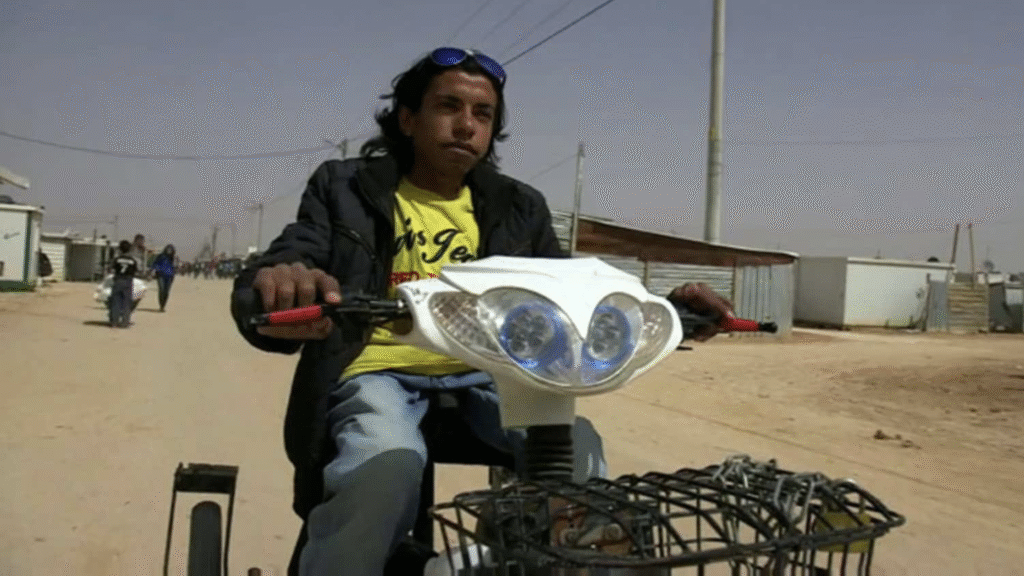
To improve his mobility, Harb engineered an electric wheelchair-bike assembled from discarded bike parts he scavenged throughout the camp. This choice was intentional; by using readily available materials, Harb ensured that other disabled residents could replicate his design. He started with a standard bicycle frame, then reimagined its rear section to accommodate a person who needed a larger seat. For support, Harb replaced the single back wheel with two. Lastly, Harb wired five 12-volt batteries to power a hand-control system. This last design change allowed the electrical system to be recharged, a crucial feature in a camp with limited power access.
This invention transcended mere transportation; it allowed Harb to traverse the camp independently. The wheelchair-bike transformed him from a confined observer into an active participant in camp life. In creating the device, Harb did not simply build adaptive equipment; he remade himself, forging a new identity as inventor and problem-solver. The wheelchair-bike enabled movement while he remained emplaced, offering freedom within confinement.
Though Harb also founded the Syrian Art Group, a scriptwriters group with his brothers, his wheelchair-bike became Harb’s most recognized achievement, earning him media attention. In one interview, Harb reflected on how disability compels creativity; it forces him to reimagine the possibilities of his life, finding ingenious pathways through seemingly impossible obstacles.
Connection to Mobile Networked Creativity
Mobile Networked Creativity examples like Harb’s wheelchair-bike represent acts of self-determination to exert control over one’s immediate environment when larger forces of displacement strip away autonomy. Safwan Harb’s invention tells a layered story of emplacement at the Za’atari refugee camp indefinitely, waiting either for resettlement or the impossible return home. Harb was forced to confront the paradox of being simultaneously displaced and fixed in place, a tension that compelled him to engineer mobility within immobility. Harb not only created transportation, but also access to resources, community, and participation in camp life that would otherwise remain beyond reach. While Harb’s ingenuity and perseverance merit celebration, the oppressive mobility politics that necessitated his invention do not. Harb’s wheelchair-bike should not need to exist; its existence indicates the systemic failures that leave disabled refugees navigating unplanned, inaccessible spaces with no institutional support. Ultimately, Mobile Networked Creativity illuminates what formal systems refuse to see: the critical gaps in resources, infrastructure, and dignity that force marginalized people to become involuntary innovators.
Location
Za’atari refugee camp, Jordan
To Learn More
- PBS NewsHour, “World’s Largest Syrian Refugee Camp Has Developed Its Own Economy,” PBS NewsHour, June 18, 2016.
- Zeena Saifi, “Refugees use art to make Zaatari Refugee camp home,” CNN, July 31, 2018.
- Jen Copestake, “Refugee Inventor Builds Electric Bike,” BBC News, March 26, 2016.
- Adriana de Souza e Silva and Mai Nou Xiong-Gum, “Mobile Networked Creativity: Developing a Theoretical Framework for Understanding Creativity as Survival,” Communication Theory 31, no. 4 (2021): 821–40.
- Ana Duarte, “Refugee Invents Device to Help Disabled People Go Around,” Patient Innovation, May 30, 2016.