

Description
Hungary has been a major transit country for immigrants entering Western European countries, such as Austria and Germany. To hinder the flow of human migration, Hungary closed its border with Croatia in 2015. The border was closed off with a 216-mile razor-wire border fence. Forced migrants could not pass through, but migrants could still apply for asylum in Hungary at two border transit zones located in Beremend and Letenje. New encampments formed for those stranded in transit by the border fence. Some of these locations were on the edge of Croatia. Although the camp was very densely populated, it didn’t have the infrastructure of a city. This caused the camps to experience internet precarity.
The initial phase to solve the internet precarity in the encampment had locals provide refugee holding centers with free wireless access and prepaid 3G data cards. Unfortunately, this initial plan failed due to overcrowding, which caused the 3G network to not support that many users. Project Open Network originally used 3G instead of 2G as it has a larger bandwidth than 2G and supports internet browsing. But it has a slower speed than 4G and 5G, which are two networks that can handle more data traffic. This created slow and unstable internet connections in the encampment.
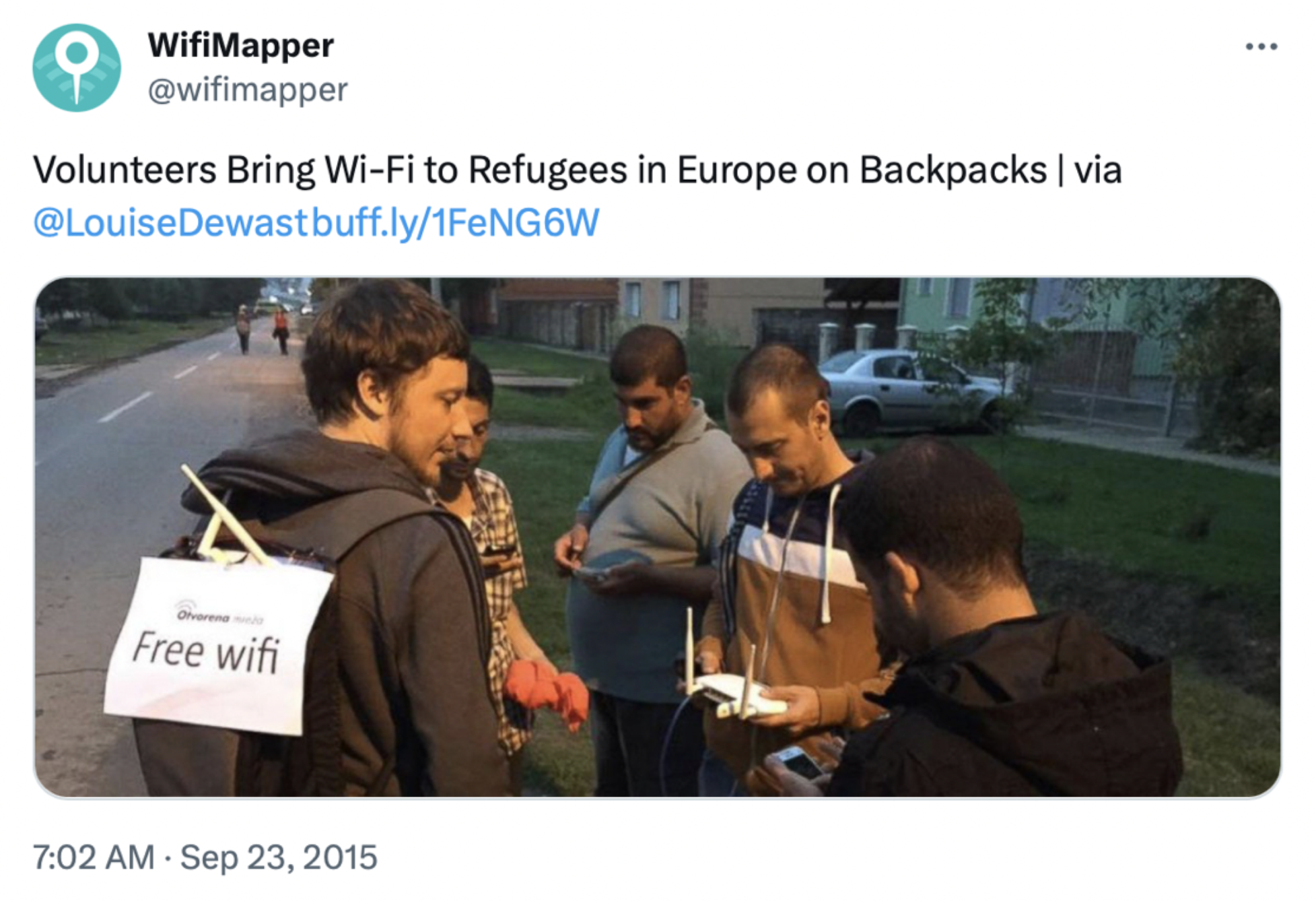
Volunteers from local cellular carriers like Vipnet and Tele2 Hrvatski had another solution called Project Open Network (Otvorena mreža). Project Open Network was a group of volunteers who collected donated SIM cards, along with 3G USB sticks and external batteries, then assembled the available technologies to build mobile Wi-Fi routers that were mounted on bookbags. Volunteers walked into the Opatovac Refugee Camp, in Tovarnik, Croatia, carrying the bookbags equipped with the mobile Wi-Fi routers to crowded locations to provide mobile internet to the refugees.
Volunteers from local cellular carriers like Vipnet and Tele2 Hrvatski had another solution called Project Open Network (Otvorena mreža). Project Open Network was a group of volunteers who collected donated SIM cards, along with 3G USB sticks and external batteries, then assembled the available technologies to build mobile Wi-Fi routers that were mounted on bookbags. Volunteers walked into the Opatovac Refugee Camp, in Tovarnik, Croatia, carrying the bookbags equipped with the mobile Wi-Fi routers to crowded locations to provide mobile internet to the refugees.
As Project Open Network gained traction, officials saw that the forced migrants had a need for internet access. Officials proceeded to make formal attempts to wire the camp with the internet became a priority. In addition to the Wi-Fi book bags hotspots, they have a website that offers the community opportunities to ask questions and provides tutorials about how to create mobile Wi-Fi routers.
Connection to Mobile Networked Creativity
This example of Mobile Networked Creativity is a collaborative and adaptable creation that brings people, available technologies, and spaces together. The creation is a response to the emplacement of forced migrants who are supposed to be in transit but are barred from moving forward. It allowed the forced migrants some agency to bring their immediate space of emplacement under some control. At the same time, it turned these forced migrants and the Wi-Fi mobile hotspots into direct and concrete advocates of human rights, with officials even agreeing with them and implementing permanent Wi-Fi into the encampments.
Location
Opatovac Refugee Camp, Tovarnik, Croatia
To Learn More
- BBC News, “Migrant Crisis: Hungary Closes Border with Croatia – BBC News,” 2015.
- Rick Lyman, “Hungary Seals Border With Croatia in Migrant Crackdown,” The New York Times, October 16, 2015, sec. World.
- “XO88 Top Class Betting House in the UK,” XO88 House.
- Jean d’Arcy, “The Right to Man to Communicate,” in Right to Communicate: Collected Papers, ed. L.S. Harms, Jim Richstad, and K.A. Kie (Honolulu: University of Hawaii at Manoa, 1977).
- Koen Leurs, “Communication Rights from the Margins: Politicising Young Refugees’ Smartphone Pocket Archives,” International Communication Gazette 79, no. 6–7 (November 2017): 674–98.